
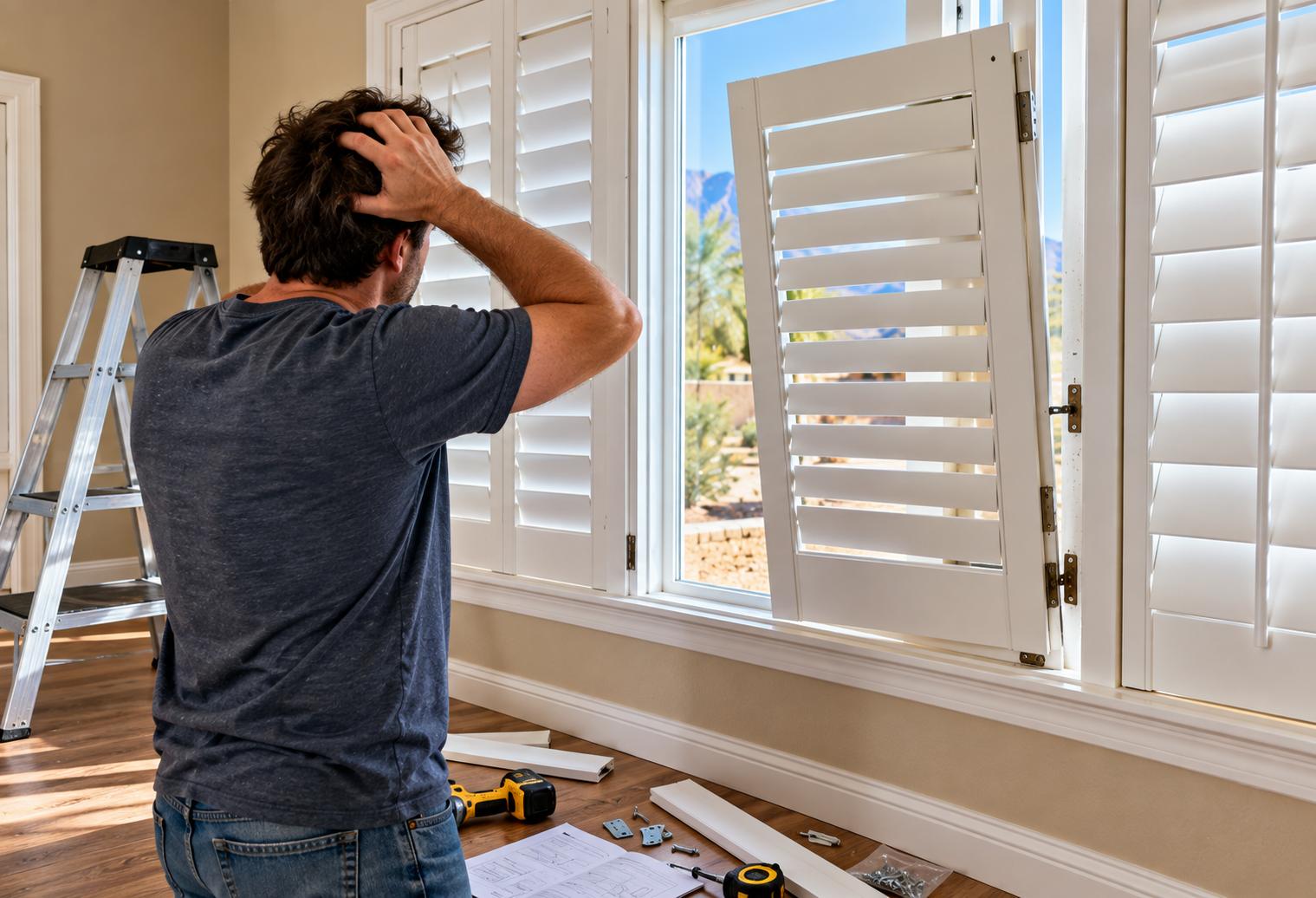
Installing shutters can look straightforward until the panels do not close evenly, the frame sits crooked, or a measurement error leaves a visible gap around the window. For homeowners in Moreno Valley, those problems can be especially frustrating when shutters are being added to help control intense Inland Empire sunlight and indoor heat.
Quick answer: DIY shutter installations usually fail because accurate measuring, proper frame alignment, secure mounting, and precise panel adjustments require more than basic home improvement skills. A small mistake at the beginning can affect how the entire shutter operates. Professional shutter installation helps avoid damaged trim, poorly fitting panels, uneven gaps, and the expense of correcting an installation that did not go as planned.
What local homeowners should know
-
Shutter measurements need to account for the actual shape and dimensions of each individual window opening.
-
Moreno Valley’s hot, bright summers make effective window coverage particularly valuable on windows receiving substantial direct sunlight.
-
Older areas such as Sunnymead and Edgemont can include homes with different window styles and construction details than newer subdivisions.
-
A shutter that looks level at first can still bind, sag, or close poorly if its frame is not square.
-
DIY mistakes may turn a planned weekend improvement into additional material costs or professional correction work.
Blinds 4 Less helps local homeowners with window covering solutions, and we know the installation stage is just as important as selecting a shutter that looks right in the room.
Why Does Proper Shutter Installation Matter in Moreno Valley?
Proper shutter installation matters in Moreno Valley because shutters need to fit and operate correctly while providing the light control, privacy, and finished appearance homeowners expect, especially in a semi-arid Inland Empire climate where summer temperatures commonly reach the high 90s and can climb above 100°F, according to City of Moreno Valley climate planning documents.
Homes across Sunnymead Ranch, Rancho Belago, Edgemont, and neighborhoods near Box Springs Mountain do not all have identical windows. Even windows that appear standard can have slightly different dimensions or openings that are not perfectly square.
That makes shutters less forgiving than window coverings with flexible fabric. The frame and panels must work together precisely. When the installation is off, homeowners may notice uneven reveals, panels that rub, or shutters that simply do not look integrated with the window.
What Are the 7 Most Costly DIY Shutter Installation Mistakes?
The seven most costly DIY shutter installation mistakes are inaccurate measurements, assuming windows are square, choosing the wrong mounting approach, failing to locate secure mounting points, forcing frames into alignment, adjusting panels incorrectly, and overlooking how nearby handles, trim, furniture, or other obstructions affect shutter operation.
1. Measuring the Window Only Once
Mistake: A homeowner takes one width and one height measurement and assumes the opening is uniform.
Consequence: If the window narrows, widens, or changes slightly from top to bottom, the shutter may not fit correctly. Even a relatively small discrepancy can become obvious once a rigid shutter frame is installed.
Better approach: Measure each opening carefully at multiple points and follow the measurement requirements for the specific shutter and mounting configuration.
2. Assuming the Window Opening Is Perfectly Square
Mistake: The DIY installer assumes straight-looking trim means the entire opening is square.
Consequence: The shutter frame may follow an irregular opening, leaving panels that rub, swing unevenly, or have noticeably inconsistent gaps.
This can be especially relevant when working across Moreno Valley’s mix of older and newer housing. The city’s planning documents identify older development around areas such as Sunnymead and Edgemont as well as newer residential areas.
Better approach: Check the opening for level, plumb, and square before deciding how the shutter should be positioned.
3. Choosing the Wrong Inside or Outside Mount
Mistake: A homeowner chooses a mounting style based mainly on appearance without considering window depth, trim, handles, or clearance.
Consequence: An inside-mounted shutter may interfere with hardware or lack sufficient mounting space. An outside mount can look awkward if its frame placement was not considered before ordering.
Better approach: Evaluate the complete window assembly before selecting the mounting configuration.
4. Mounting the Shutter Without Adequate Support
Mistake: Screws are installed wherever they seem convenient instead of where the shutter frame can be properly secured.
Consequence: A poorly supported frame can shift or loosen, affecting alignment and operation. Repeatedly opening and closing the panels can make an unstable installation more noticeable.
Better approach: Determine the appropriate attachment points for the wall or window construction and use suitable mounting hardware.
5. Forcing the Frame to Match an Uneven Opening
Mistake: The installer tightens fasteners aggressively to pull a frame against an irregular surface.
Consequence: The frame itself can become distorted. Once that happens, doors that initially appeared properly aligned may bind or develop inconsistent gaps.
In an area where shutters may be opened and closed regularly to manage bright afternoon sunlight, smooth operation matters.
Better approach: Keep the shutter frame square during installation and make controlled adjustments rather than using fastener pressure to force alignment.
6. Skipping Final Panel and Hinge Adjustments
Mistake: The project is considered finished as soon as the frame is attached.
Consequence: Panels can sit at different heights, meet unevenly, or fail to close as intended. A shutter may technically be installed while still looking unfinished.
Better approach: Test every panel through its full movement, inspect spacing, and make the appropriate final adjustments before considering the installation complete.
7. Forgetting About Real-World Clearance
Mistake: Measurements focus on the window opening while ignoring locks, cranks, deep trim, nearby walls, furniture, or other obstructions.
Consequence: A correctly sized shutter can still be inconvenient if panels cannot open fully or existing window hardware interferes with operation.
Better approach: Treat the surrounding space as part of the installation. Check how the shutter will function before ordering and again before mounting.
What Warning Signs Suggest a DIY Shutter Installation Has Gone Wrong?
A DIY shutter installation may need correction when panels rub, doors swing by themselves, gaps look inconsistent, frames pull away from the mounting surface, louvers or panels do not operate normally, fasteners loosen, or the shutter requires unusual force to open and close.
Watch for these specific signs:
-
One panel sits higher or lower than another.
-
The gap around the panels changes noticeably from top to bottom.
-
A shutter door will not remain in the intended position.
-
The frame appears bowed or twisted.
-
Opening the shutter causes rubbing or scraping.
-
Window handles interfere with the shutter.
-
Mounting points begin to feel loose.
Do not keep forcing a shutter that binds. Doing so can place additional stress on hardware or mounting points instead of addressing the underlying alignment problem.
When Should You Call a Professional Shutter Installer?
A professional shutter installer is worth considering when measurements are uncertain, openings are visibly uneven, windows have unusual shapes or limited clearance, multiple shutters need to align consistently, or a previous DIY installation already has operational problems that require diagnosis rather than another round of trial-and-error adjustments.
Homeowners can safely inspect obvious clearance issues, look for loose components, and observe where a panel appears to rub. Installation becomes more complicated when correcting frame geometry, mounting problems, or an incorrectly specified shutter.
For homeowners in Moreno Valley, professional measurement before ordering can be particularly useful when several windows throughout the house need shutters. A mistake repeated across multiple openings can become far more expensive than catching the issue at the first window.
How Can Homeowners Prevent Shutter Installation Problems?
Homeowners can prevent most shutter installation problems by measuring every window individually, checking openings for square, identifying obstructions before ordering, selecting the correct mounting method, and resisting the temptation to assume two similar-looking windows have identical dimensions.
A practical pre-installation checklist includes checking:
-
Width and height at multiple locations
-
Window depth
-
Trim configuration
-
Locks, handles, and cranks
-
Nearby walls or corners
-
Furniture and other opening obstructions
-
Whether the opening is level, plumb, and square
This preparation is useful throughout Riverside County, but it is particularly relevant for homes spanning different development periods and building styles in the Moreno Valley area.
What Results Should You Expect From a Proper Shutter Installation?
A properly installed shutter should look intentionally fitted to the window, open and close smoothly, maintain visually consistent spacing, and provide practical control over privacy and sunlight without requiring excessive force or improvised fixes.
For homes exposed to strong Inland Empire sun, shutters can also help homeowners manage how much direct sunlight enters a room. The National Weather Service includes the city within the Riverside County Valleys and Inland Empire forecast area, where periods of extreme summer heat can occur.
The goal is not simply to attach a shutter to a wall. The finished window covering should operate naturally and complement the room.
What Is a Common Local DIY Shutter Scenario?
A common local scenario is a homeowner measuring several similar windows, ordering shutters based on the assumption that the openings match, and discovering during installation that one opening is slightly different or less square than the others.
The first shutter may appear acceptable, while another rubs at one corner or shows an uneven gap. Tightening the frame can make the problem worse rather than correcting it.
This is not a specific Blinds 4 Less customer case. It is an example of why each window should be evaluated independently, whether the home is near Sunnymead Boulevard, in Rancho Belago, or closer to Lake Perris.
Is DIY or Professional Shutter Installation the Better Option?
DIY shutter installation can be reasonable for an experienced homeowner with the right tools and straightforward windows, while professional installation is generally the stronger option when precision, multiple windows, unusual openings, difficult mounting conditions, or avoiding costly rework matters more than minimizing the initial installation expense.
DIY may save labor expense when everything goes correctly. The tradeoff is that the homeowner also assumes responsibility for measuring, ordering, mounting, alignment, and troubleshooting.
Professional help can reduce that uncertainty by treating measurement and installation as parts of the same finished result.
Where Do We Provide Shutter Solutions?
We serve homeowners in Moreno Valley and can discuss availability for nearby communities in the surrounding Riverside County area. If you are unsure whether your property is within our service area, contact us before planning your project.
What Can Happen If You Ignore a Poor Shutter Installation?
Ignoring a poor shutter installation can allow minor alignment or mounting problems to become more disruptive, including continued rubbing, loose attachment points, difficult operation, visible gaps, or the eventual need to remove and reinstall part of the shutter assembly.
The cost is not always dramatic damage. Sometimes it is paying twice for the same project because incorrectly measured components cannot be solved through adjustment alone.
Frequently Asked Questions About Shutter Installation
Can I install shutters myself in Moreno Valley?
Yes, homeowners can install shutters themselves, but success depends on accurate measuring, proper tools, suitable mounting conditions, and careful alignment. Rigid shutter frames leave less room for measurement and installation errors, so homeowners who are uncertain about their window openings may benefit from professional measurement and installation.
Does Moreno Valley’s heat make shutters a good window covering option?
Shutters can provide useful control over direct sunlight and privacy in a hot Inland Empire climate. City climate planning materials describe local summers as hot and dry, with average summer temperatures in the high 90s and many days exceeding 100°F, making sunlight management an important consideration for many households.
Are older Moreno Valley homes harder to measure for shutters?
Older homes are not automatically harder, but homeowners should never assume their window openings remain perfectly square or uniform. City planning documents identify older development around Sunnymead and Edgemont, while other parts of the community contain newer subdivisions, creating a varied local housing stock where individual measurement remains important.
Should every window be measured separately?
Yes, every window should be measured separately even when several openings look identical. Small dimensional differences can matter with a fitted shutter system. Recording multiple measurements for each opening helps identify variations before shutters are ordered rather than discovering them halfway through installation.
Can shutters help with strong afternoon sun in Riverside County?
Yes, shutters allow homeowners to adjust how much direct sunlight enters through a window, which can be useful on exposures receiving intense afternoon sun. They should be viewed as one part of managing indoor light and comfort rather than as a substitute for an appropriately sized and maintained cooling system.
What if my window is not square?
An out-of-square window does not necessarily prevent shutter installation, but it makes careful measurement and frame positioning more important. The installer needs to account for the actual opening rather than forcing the shutter frame to follow an irregular surface and potentially creating operational problems.
Is professional measurement worth it before ordering shutters?
Professional measurement can be especially valuable when ordering shutters for multiple rooms, unusually shaped openings, limited mounting depths, or windows with noticeable variations. Accurate specifications at the beginning reduce the risk of discovering after the product arrives that an opening, obstruction, or mounting condition was overlooked.
When should I stop trying to fix a DIY shutter installation?
Stop and seek professional help when the frame is visibly distorted, mounting points are unstable, panels repeatedly bind, or you are considering modifying the shutter simply to make it fit. Continuing to force components into place can turn an alignment issue into a more complicated correction.
Get Shutters That Fit the Window and the Way You Live
A successful shutter project starts with accurate measurements and ends with smooth, properly aligned operation. We can help Moreno Valley homeowners explore shutter options with the local climate, window configuration, light control, and everyday usability in mind.