
Moreno Valley summers can put window coverings to the test. Strong afternoon sun pouring through west-facing glass can quickly make bedrooms, living rooms, offices, and other spaces feel warmer, especially during stretches of triple-digit Inland Empire heat.
If reducing indoor heat is one of your main goals, the type of blind or shade you choose matters. Some window treatments mainly control light and privacy, while others add insulation and reduce the amount of solar heat entering the room.
Quick answer: Insulated cellular shades are generally one of the strongest interior window-covering choices for reducing heat because their honeycomb-shaped cells trap air and create an insulating layer at the window. Reflective or blackout roller shades can also perform well against direct sunlight, while solar shades are useful for reducing glare and solar exposure without completely blocking the view. Standard horizontal blinds help, but typically provide less insulation.
What local homeowners should know
-
Cellular shades are especially useful when both insulation and sunlight control are priorities.
-
West-facing windows in Moreno Valley often deserve extra attention because they can receive intense afternoon sun during the hottest part of the day.
-
Light-colored or reflective window coverings can help send more incoming solar energy back toward the glass instead of absorbing it indoors.
-
Solar shades can be a practical choice when residents want heat and glare control while maintaining some outdoor visibility.
-
The best choice depends on window orientation, fit, room use, privacy needs, and how much natural light you want to preserve.
Why Does The Right Window Covering Matter In Moreno Valley?
The right window covering matters in Moreno Valley because reducing solar heat at the glass can improve comfort in rooms exposed to prolonged summer sun and reduce some of the cooling burden placed on the home. Window orientation, glass type, shade fit, and how consistently the covering is used all affect the result.
The National Weather Service’s Riverside Municipal Airport climate records provide useful context for the surrounding region. July’s 1991 to 2020 normal daily high is around 94 degrees, and hotter days regularly occur. Those conditions help explain why rooms with large, uncovered windows can become uncomfortable quickly.
Local housing also varies considerably. The City of Moreno Valley identifies areas including Sunnymead, Edgemont, Rancho Belago, the Northwest Area, Central Area, and South Area. Different construction periods, window sizes, orientations, and floor plans can make heat problems noticeably different from one home to another.
Blinds 4 Less helps local property owners evaluate window-covering options for their individual spaces. From this point forward, we focus on matching the covering to the window instead of assuming one style is ideal everywhere.
Which Blinds And Shades Reduce Heat The Most?
Insulated cellular shades generally provide the strongest combination of interior shading and insulation, while reflective roller shades and solar shades can also be effective depending on whether the main priority is maximum heat control, room darkening, or preserving the view. Conventional blinds can reduce direct sun but usually offer less insulation.
Here is how the most common choices compare.
Cellular shades
Cellular shades, sometimes called honeycomb shades, contain pockets that trap air between the room and the window.
The U.S. Department of Energy identifies well-fitted cellular shades as a particularly effective energy-efficient window attachment. Their design helps reduce unwanted solar heat gain while also adding insulation at the glass.
For Moreno Valley homes with hot upstairs rooms, large bedroom windows, or prolonged afternoon exposure, cellular construction can be especially worth considering.
Blackout or reflective roller shades
Roller shades made with opaque, reflective, or room-darkening materials can substantially reduce the sunlight entering a room.
A lighter or reflective exterior-facing surface can be particularly useful because it reflects more solar energy instead of absorbing as much of it. These shades can work well in bedrooms, media rooms, nurseries, and other spaces where reducing light is also desirable.
Solar shades
Solar shades are designed to reduce glare and solar exposure while maintaining varying degrees of outward visibility.
They are often a useful option for living areas, offices, sliding-door areas, and rooms where completely blocking the outdoor view would feel restrictive. Their performance depends heavily on fabric openness, color, and window exposure.
Horizontal blinds
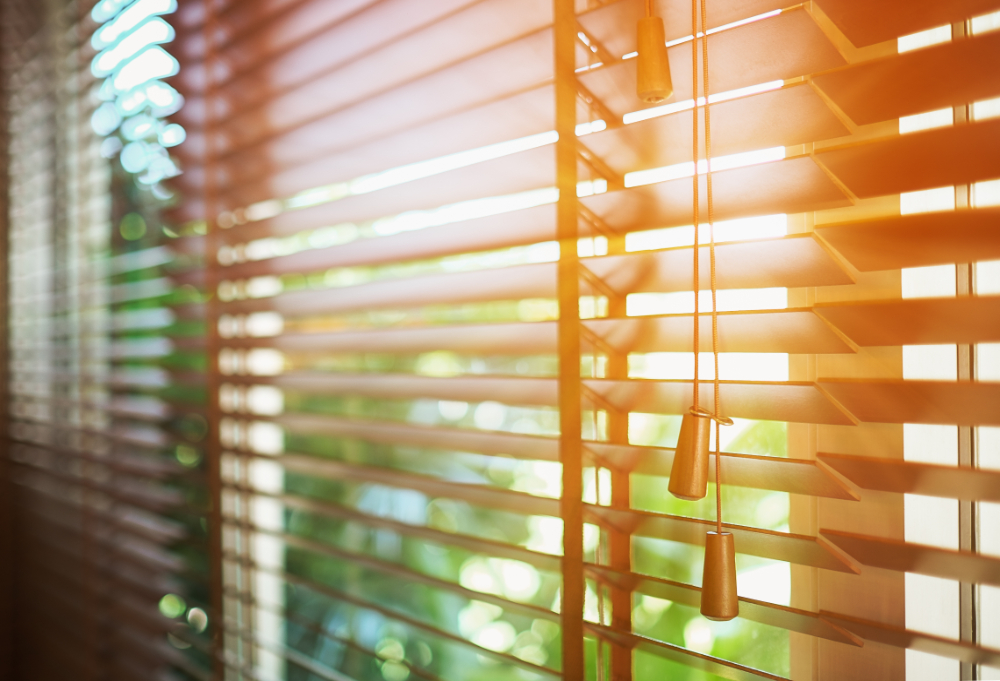
Wood, faux wood, aluminum, and similar slatted blinds can reduce direct sunlight when fully closed and positioned correctly.
They provide useful control because the slats can be tilted as sunlight moves through the day. However, the U.S. Department of Energy notes that conventional blinds generally do not provide as much insulation as cellular products.
What Does Local Climate Data Tell Moreno Valley Homeowners?
Local climate data shows that the Moreno Valley area experiences sustained summer heat that makes solar heat gain through windows a practical comfort concern rather than an occasional problem. Nearby National Weather Service measurements regularly show summer afternoons in the 90s and periods above 100 degrees.
For example, Riverside Municipal Airport recorded a high of 104 degrees on July 15, 2026. Its climate normal for July includes daily high temperatures around the mid-90s.
That does not mean every home experiences identical indoor conditions. Shade trees, window direction, roof exposure, glazing, insulation, air conditioning, and surrounding buildings all influence how quickly a room heats.
Still, the regional pattern makes window shading particularly relevant throughout western Riverside County.
How Does Window Heat Affect Local Homes?
Window heat can make individual rooms warmer, increase glare, create uneven temperatures from one side of the house to another, and cause occupants to rely more heavily on air conditioning during hot Moreno Valley afternoons. South-facing and especially west-facing glass can become important sources of unwanted solar gain.
A room near Box Springs Mountain may have different exposure than a property farther east toward Rancho Belago. Homes near Sunnymead Boulevard, Alessandro Boulevard, or newer subdivisions can also differ considerably in window size and orientation.
Common effects include hot bedrooms in late afternoon, uncomfortable seating areas near glass, faded furnishings, bright television glare, and upstairs rooms that stay warm after the sun begins to set.
What Are The Signs Your Current Blinds Are Not Controlling Heat Well?
Your current blinds may not be controlling heat effectively if rooms remain noticeably hotter near windows, direct sunlight penetrates the covering, or the window treatment leaves significant gaps that allow intense solar exposure into the space. Comparing rooms with different window orientations can make these problems easier to identify.
Watch for these signs:
-
The room feels much warmer during the afternoon than it does in the morning.
-
Furniture, flooring, or countertops near the window become hot to the touch.
-
Strong sunlight passes between slats even when the blinds are closed.
-
Large gaps exist around the sides of the window covering.
-
You experience persistent glare on televisions or computer screens.
-
Upstairs rooms facing west remain uncomfortable late into the evening.
-
Existing blinds feel hot and appear to radiate warmth toward the room.
-
You keep lowering the thermostat to compensate for one or two particularly warm rooms.
When Should You Ask A Window-Covering Professional For Help?
Professional guidance is useful when you are unsure which material, opacity, fit, or operating style will give a particular window the heat control you want without sacrificing privacy, light, appearance, or everyday convenience. Large windows, specialty shapes, and strong west-facing exposures can particularly benefit from accurate product selection and measurement.
Homeowners can safely start by noting which rooms get hottest and at what time of day. You can also observe whether sunlight enters from the east in the morning or west later in the afternoon.
Professional help becomes more valuable when comparing cellular construction, solar-shade openness, blackout materials, inside versus outside mounting, or coverings for unusually large windows and doors.
What Causes Some Moreno Valley Rooms To Get Hotter Than Others?
The most common reasons some Moreno Valley rooms become hotter are window orientation, direct afternoon sun, large areas of exposed glass, insufficient shading, loose-fitting window treatments, and differences in the home’s construction or insulation. These factors often combine rather than occurring individually.
1. West-facing exposure
West-facing windows receive strong afternoon sunlight when outdoor temperatures are often near their daily peak.
2. Large windows and sliding doors
More glass means more surface area through which sunlight can enter. Large openings can therefore require greater attention to fabric choice and coverage.
3. Loose-fitting window coverings
Large gaps around a shade allow additional light to enter and can reduce the insulating benefit of the covering.
4. Dark materials exposed to direct sunlight
Dark surfaces often absorb more solar energy. Depending on the product design, lighter exterior-facing surfaces may offer better heat-reflecting characteristics.
5. Different building layouts
A second-story bedroom with limited shade can behave very differently from a first-floor room protected by a porch, neighboring structure, or mature landscaping.
How Can You Get Better Heat Control From Your Window Coverings?
You can improve heat control by closing coverings before strong sunlight reaches the glass, prioritizing the hottest windows first, choosing a close-fitting product, and selecting materials designed for insulation or solar control. Good daily use matters because even an effective covering cannot reduce solar gain while fully open.
During hot Inland Empire weather, consider closing west-facing shades before the afternoon sun begins striking the windows directly.
Other practical steps include:
-
Keep cellular shades fully lowered during peak sun when maximum insulation is needed.
-
Tilt horizontal blinds so direct beams are redirected away from occupied areas.
-
Consider room-darkening materials in bedrooms with severe afternoon exposure.
-
Use solar shades where reducing glare while preserving the view is more important.
-
Check for excessive side gaps before assuming the covering itself is ineffective.
-
Combine window coverings with existing exterior shade from patio covers, landscaping, or architectural overhangs where available.
The U.S. Department of Energy notes that exterior shading is especially effective because it intercepts solar energy before it reaches the glass. Interior shades still provide valuable comfort and glare-control benefits.
What Results Can You Expect From Heat-Reducing Blinds?
Heat-reducing blinds and shades can make sunny rooms feel more comfortable, reduce direct solar exposure, lessen glare, and help moderate temperature differences near windows, but they cannot replace adequate insulation or a properly functioning cooling system. Results vary according to the covering, window, fit, glazing, orientation, and daily use.
The biggest improvement is often experienced at windows receiving sustained direct sun.
A cellular shade fitted closely to the opening, for example, can add an insulating layer that a basic slatted blind does not provide. A solar shade may provide less insulation but may better suit a room where preserving daylight and visibility matters.
The goal should be choosing the treatment that solves the actual problem in that room.
What Mistakes Reduce The Effectiveness Of Window Blinds?
The biggest mistakes are choosing window coverings only by appearance, ignoring window direction, leaving large installation gaps, and expecting every room to perform the same with the same product. A better approach is to match material, fit, opacity, and operating style to each area’s exposure and use.
Mistake: Choosing the same blind for every window.
Consequence: A product that works on a shaded north-facing window may disappoint on a west-facing bedroom.
Better approach: Prioritize each window according to sun exposure.
Mistake: Leaving blinds open until the room is already hot.
Consequence: Solar energy has already entered the space.
Better approach: Close coverings before peak sun reaches the glass.
Mistake: Ignoring fit.
Consequence: Side gaps can allow substantial beams of sunlight into the room.
Better approach: Measure carefully and select the mounting approach that provides appropriate coverage.
Mistake: Assuming blackout automatically means maximum insulation.
Consequence: A blackout material may block light very well without providing the air-trapping construction of a cellular shade.
Better approach: Compare both light control and insulating design.
What Is A Common Moreno Valley Heat-Control Scenario?
A common Moreno Valley scenario is an upstairs bedroom with a west-facing window that feels comfortable in the morning but becomes noticeably warmer from mid-afternoon through sunset. Closing ordinary blinds reduces glare, yet heat can still be felt near the window because the slats provide limited insulation.
In this situation, a well-fitted cellular shade may be worth comparing with a blackout roller shade.
The cellular option emphasizes insulation and solar-heat control. The blackout roller option emphasizes strong light blockage and can also reduce solar exposure, particularly with an appropriate backing.
The preferred choice depends on whether insulation, darkness, appearance, or operating simplicity matters most.
Which Window-Covering Solutions Are Worth Comparing?
The most useful solutions to compare are cellular shades for insulation, blackout roller shades for maximum light control, solar shades for glare reduction and visibility, and adjustable blinds for flexible light direction. Each can reduce solar exposure, but their performance and daily experience differ.
We can help homeowners compare options based on window exposure, room function, desired privacy, appearance, and preferred level of light control.
How Do Cellular Shades, Solar Shades, And Blinds Compare?
Cellular shades usually offer the strongest insulation, solar shades are better suited to maintaining outward visibility, and standard blinds offer convenient adjustable light control but less insulating performance. Choosing among them means deciding whether temperature control, darkness, view, privacy, or flexibility matters most in that particular room.
| Option | Heat Control | Light Control | View | Best Fit |
|---|---|---|---|---|
| Cellular shades | Strong | Moderate to strong | Limited when closed | Hot rooms and insulation |
| Blackout roller shades | Strong solar blocking | Very strong | None when closed | Bedrooms and media rooms |
| Solar shades | Moderate to strong solar control | Moderate | Partial | Living spaces and offices |
| Horizontal blinds | Moderate | Highly adjustable | Adjustable | Flexible everyday light control |
Where Do We Serve Around Moreno Valley?
We serve customers in Moreno Valley and can discuss nearby service availability based on the property’s location. Local areas may include communities around Riverside, Perris, and other parts of western Riverside County, subject to our current service boundaries.
What Can Happen If You Ignore Excessive Window Heat?
Ignoring persistent window heat can leave rooms less comfortable, increase glare, expose furnishings to more direct sunlight, and encourage greater reliance on air conditioning during Moreno Valley’s hottest weather. Addressing the windows that receive the most direct sun can be a practical first step instead of treating every opening identically.
Waiting also means spending another hot season adjusting blinds that may not be designed for the problem you are trying to solve.
Frequently Asked Questions About Heat-Reducing Blinds In Moreno Valley
What type of blinds keeps a house coolest in Moreno Valley?
Insulated cellular shades are generally one of the strongest interior choices for keeping sunny rooms cooler because their honeycomb structure traps air at the window. Reflective roller shades and solar shades are also worth considering, particularly where the main concern is direct sunlight rather than insulation alone.
Are cellular shades worth it for Moreno Valley’s summer heat?
Cellular shades can be especially useful during Moreno Valley’s hot summers because they combine sunlight control with an insulating air layer at the window. They are worth comparing for west-facing bedrooms, upstairs spaces, and other rooms where ordinary slatted blinds do not provide enough comfort.
Are blackout blinds better than solar shades for heat?
Blackout coverings are better when maximum light blockage is the priority, while solar shades are usually better when you still want daylight and some outdoor visibility. Both can reduce solar exposure, but the best heat-control result depends on fabric construction, color, openness, fit, and the window itself.
Which windows should Moreno Valley homeowners cover first?
West-facing windows are often a smart place to start because they receive strong afternoon sunlight during the hottest part of many summer days. South-facing glass can also experience significant solar exposure. Walk through your home during the afternoon and identify the rooms that show the largest temperature and glare problems.
Does closing blinds actually keep a Moreno Valley home cooler?
Closing blinds and shades before direct sunlight enters can help reduce unwanted solar heat gain, although the amount depends on the covering. Insulating cellular shades typically outperform basic blinds for thermal control, while properly positioned blinds can still reduce direct sun and make rooms more comfortable.
Should I choose light or dark window coverings for hot rooms?
A light or reflective surface facing the window can be advantageous for solar control because it reflects more incoming energy rather than absorbing as much of it. Product construction matters too, so color should be considered alongside insulation, fabric openness, backing, fit, and the amount of direct Riverside County sun.
Can window shades lower my air-conditioning bill?
Effective window shades can reduce some of the solar heat entering a home and may reduce cooling demand, but the exact energy impact varies too much to promise a specific savings amount. Window type, HVAC efficiency, insulation, thermostat habits, shade use, and sun exposure all contribute to the final result.
Are solar shades good for west-facing windows in Moreno Valley?
Solar shades can work well on west-facing windows when controlling intense afternoon glare and solar exposure is important but preserving the view is still desired. For a room where maximum insulation is more important than visibility, cellular shades may be the stronger option to compare.
Make Your Hottest Rooms More Comfortable
Choosing a window covering for Moreno Valley heat starts with identifying where the sun enters, how much light you want to keep, and whether insulation or glare reduction matters most. We can help you compare practical options without assuming the same covering belongs on every window.